News

 Plastic pollution threatens jobs

Impact on farming Plastic pollution poses a significant hazard to farm animals,  they can choke on plastic or swallow it and then die of malnutrition. Studies have found that in some low- and middle-income countries, up to a third of cattle and half of the goat population have consumed significant amounts of plastic which they have mistaken for food.[1] This a particular problem  in animals residing in urban areas of developing countries. Ingested plastic materials in the rumen slowly release the  then enter the food chain through milk and meat products. These chemicals have a detrimental effect on human health. Another challenge is that people may not want to buy meat from that farmer, if they have seen cows eating plastic or dirty nappies! Plastic pollution also hampers crop growth by obstructing the flow of water and air in the soil. Impact on Fishing Fish are similarly affected: for those who rely on their livestock and fishing for their income, this is particularly devastating.[2] Once of the big challenges with fish and plastics is when smaller organisms ingest microplastics it eventually makes its way up the food chain to humans. For example if a small fish  eat 10 pieces of microplastic and a larger fish eats ten fish, now it has ingested 100 pieces of microplastic. Another big challenge is what is known at ‘ghost fishing’  which refers to  fishing gear that has been lost or abandoned. Nets, long lines and fish traps continue to trap and kill fish, leading to drops in stock of available fish. After major  storms wash plastic downstream to the harbours, we often find that boats lose hours of working time as they have to untangle propellors from plastic, or find their engines damaged Impact on tourism And in many places where the local economy relies on tourism, unsightly plastic pollution is threatening businesses and curtailing growth. All of this makes it harder for families to lift themselves out of poverty and to plan for the future.[3] With the increase in social media, tourists increasingly post photos of polluted beaches or rivers ,which can discourage other visitors from coming [1] Ruminal impaction due to plastic materials -https://www.ncbi.nlm.nih.gov/pmc/articles/PMC6200578/ [2] How ocean plastics impact fisheries https://www.aftco.com/blogs/conservation/how-ocean-plastics-impact-fishing-and-fisheries [3] How marine plastic pollution impacts on tourism https://www.uow.edu.au/media/2023/how-marine-plastic-pollution-impacts-countries-that-rely-on-tourism–.php

 Plastic pollution threatens jobs Read More »

Clean up for Nelson Mandela Day !

MAKE EVERY DAY A MANDELA DAY#ITISINYOURHANDS Mandela Day is an annual global celebration that takes place on 18 July to honour the life and legacy of Nelson Mandela. This day is a call to action for individuals, communities, and organisations to take time to reflect on Mandela’s values and principles and to make a positive impact in their own communities. Nelson Mandela Day is perhaps best known for its slogan, “67 Minutes of Service,” but did you know where that came from and why it is no longer the slogan? It was calculated that Nelson Mandela spent 67 years of his life in service of social justice – in his years of activism and mobilisation, his years in prison, as well as his years as president of the Republic of South Africa.  The 67 Minutes for Mandela campaign went global and became the rallying call for Nelson Mandela International Day. The 67 Minutes gives people an opportunity to take part in short, action based projects in service of their communities.  This year we are encouraging you to get together with others and spend 67 minutes (just over an hour!) in cleaning up your street or neighbourhood. Even a short term initiative like a street clean up can raise awareness of the problem of plastic pollution. It brings people together for something positive. Since 2011, the Nelson Mandela Foundation has introduced the “Make Every Day A Mandela Day” slogan, encouraging people to take responsibility for social justice in their communities every day of the year. So let us clean up for 67 minutes on Mandela Day , but have the long term vision of clean streets for Mandela! It is still in your hands! #Itisstillinyourhands   #MandelaDay2024

Clean up for Nelson Mandela Day ! Read More »

Green Anglicans at ASF conference

The Anglican Student Federation (ASF) held its annual 61st Conference from the 30th of June till 5 July 2024 at the Anglican Training Centre in Maseru Lesotho.  On the 2nd of July 2024, members of Green Anglican Lesotho, accompanied by Mr Bino Makhalanyane (Provincial Youth Coordinator ) , participated in the ASF Provincial Conference, where they had an enriching and inspiring experience. The day began with a vibrant morning prayer led by Ms Maipato Kotelo and Mr Rapelang sharing a short homily on “Responsibility came before sin , therefore taking care of creation is not punishment but a responsibility given to us all by our Creator “,these  setting a positive tone for the events to follow. One of the highlights of the conference was a presentation by Ms. Mpona Mohapi, a passionate advocate for climate action and a cloud security engineer by profession. Ms. Mohapi, who hails from Lesotho, shared her insights on generational restoration and building resilient communities in the face of climate change. Drawing on her experiences as a curator for the World Economic Forum’s Global Shapers Community and as an alumni of the Nairobi Summer School on Climate Justice, Ms. Mohapi’s presentation resonated deeply with the audience. Following Mohapi’s presentation, attendees were divided into small groups to reflect on how they could contribute to climate advocacy within their respective universities. This interactive session fostered meaningful discussions and allowed participants to brainstorm innovative ways to make a difference in their communities. Overall, the day at the ASF Provincial Conference was a powerful reminder of the importance of collective action in addressing the climate crisis. Through education, advocacy, and collaboration, Green Anglican movement and its members are committed to driving positive change and creating a more sustainable future for all. We would like to congratulate the outgoing PEC for a well-organized conference and wish well the newly elected PEC as they take over. As we reflect on the insights shared at the conference, let us be inspired to act in our own communities and work towards a greener, more resilient world for generations to come. #CaringForCreation #Gen 2:15 #GreenAnglicansLesotho By. Ms M Kotelo

Green Anglicans at ASF conference Read More »

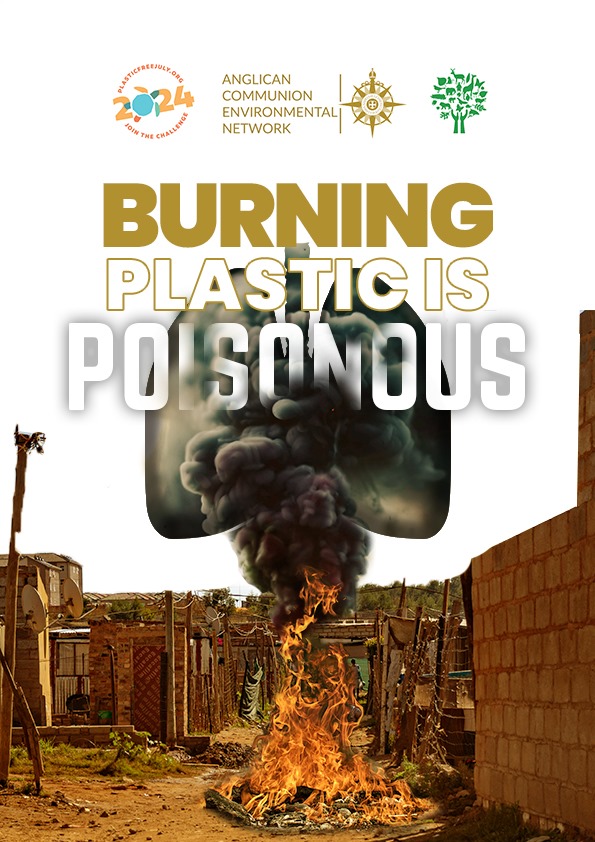
BURNING PLASTIC IS POISONOUS!

We continue our series of posts on the impact of plastic on the most vulnerable communities as part of the Plastic Free July campaign As much as one billion tonnes of waste could be burning in open fires   – almost half of the municipal solid waste generated on Earth is burned. The impact on human health in poorer communities is extreme. “Uncontrolled waste fires burn at much lower temperatures, which means combustion is incomplete. This releases substances from the waste and creates new ones as molecules are decomposed and reformed in the flames. Dioxins and related compounds are often formed when PVC is burned in open fires. At least 30 of these types of compound are considered harmful to human health. They can persist in the environment for years and in the human body for perhaps a decade or more. There is the danger that  they can damage the brain and disrupt hormones.”(Velis C, the Conversation) In wealthy countries waste may be burned in  Energy-from- waste plants (EFW), using expensive equipment . This is a very expensive process so is often exported to lower and middle income countries where it is burnt openly . Globally two billion people do not have their solid waste collected at all, which means they have no choice but to burn it or throw it in the river if there is one nearby. Another risk is that of electronic equipment, some informal recyclers burn away the PVC insulation to reach the copper and other metals  to be sold, releasing toxic fumes. The burning  of plastic waste is a massive environmental and health challenge .   It is also  an issue of injustice and environmental racism. #plasticfreejuly

BURNING PLASTIC IS POISONOUS! Read More »

Plastic waste leads to flooding

“Plastic free July”- during this month we will be focussing on the impacts of plastic waste on the most vulnerable communities. According to Tearfund almost a quarter of the world’s population (over 2 billion people) living in  low- or middle-income countries don’t have access to solid waste management. Globally, we throw away about 300 million tonnes of plastic waste every year. That’s enough to cover almost 50,000 football pitches every day! Half of all plastic is now designed to be used only once before being thrown away. In middle class suburbs, waste is picked up regularly but in informal settlements it piles up. The reasons for poor service delivery are many and multi- factored. Sometimes informal  communities are not given “wheelie bins’ by the city but only plastic bags. These then get torn open by dogs. If skips are provided they may be too far to walk to, or children cannot reach over the edge. There are also issues of safety for municipal vehicles going into certain areas. Due to the drop in value of plastic, less and less is being collected by wastepickers – virgin plastic in South Africa is now cheaper than recycled. A study at an Anglican Church revealed that a person would need to collect 300 bottles to earn the price of a loaf of bread. This means the harmful impacts of all this plastic pollution are becoming more widespread and severe. But what impact does all this rubbish have on informal settlements?. Plastic pollution can lead to  flooding disasters Plastic pollution blocks waterways and can  exacerbate flooding which can lead to huge disasters and loss of life. Many communities across the world experience regular, flash flooding on a devastating scale – even after just a small amount of rainfall – as the plastic dumped in rivers and drains means excess water has nowhere to go. These horrendous events cause loss of life, and sweep away homes and businesses, and it’s often low-income communities who have little option but to live on the riverbanks or in densely populated urban areas who suffer the most. It is  people in poverty who are most affected. Plastic rubbish lying in water is a also a breeding ground for mosquitoes, flies and vermin that can transmit diseases like malaria to people in the area. Research has shown that the incidence of diarrhoeal disease is twice as high for people living among mismanaged waste.

Plastic waste leads to flooding Read More »

Diocese of Johannesburg Servers Guild : Protect, Preserve and Improve.

As part of their service to the Lord the Diocesan Servers from Diocese ofJohannesburg met at St. James Anglican Church in Diepkloof Soweto for anenvironmental workshop.The day started off with Ms. Palesa Phayane ( Servers Environmental Affairs Coordinator) sharing the mission of having an environmentaldesk within the server’s guild. The dream is to not only grow trees or pray for theenvironment but to use this as on opportunity of restoring biodiversity while alsoputting up climate smart vegetable gardens at parishes. The produce could bedonate to local shelters, orphanage or used for parish soup kitchens. She also addedthat servers are known to be united, supportive and strong willed which is whystarting this initiative within the server’s guild gives a better chance of success. Theenvironmental initiative within the Diocesan servers guild has got both short term andlong term activities which have been outlined.Mr Bino Makhalanyane shared a presentation on the impacts and effects of climatechange under the theme of “The Earth is the Sanctuary of God”. He called onmembers of the servers’ guild , who are called to serve God within His Sanctuary tonot only limit themselves within church walls but to know and understand that thewhole earth is full of His Glory (Isaiah 6:3). Therefore we also have the responsibilityof taking care of our common home which is the earth .Attendees were then divided into six groups where each group had to design what apossible logo for the environmental desk within the diocesan Servers Guild wouldlook like.The day ended with a short wellness meditation.The motto for the Diocesan Servers Guild environmental initiative will be :PROTECT the environment so that we have a healthy place to live,PRESERVE so that future generations get to experience what we did,IMPROVE in order to enhance our lives and that of the other life forms around us Photo Credit : Ofentse Mogotsi

Diocese of Johannesburg Servers Guild : Protect, Preserve and Improve. Read More »