News

Green Anglicans at ASF conference

The Anglican Student Federation (ASF) held its annual 61st Conference from the 30th of June till 5 July 2024 at the Anglican Training Centre in Maseru Lesotho.  On the 2nd of July 2024, members of Green Anglican Lesotho, accompanied by Mr Bino Makhalanyane (Provincial Youth Coordinator ) , participated in the ASF Provincial Conference, where they had an enriching and inspiring experience. The day began with a vibrant morning prayer led by Ms Maipato Kotelo and Mr Rapelang sharing a short homily on “Responsibility came before sin , therefore taking care of creation is not punishment but a responsibility given to us all by our Creator “,these  setting a positive tone for the events to follow. One of the highlights of the conference was a presentation by Ms. Mpona Mohapi, a passionate advocate for climate action and a cloud security engineer by profession. Ms. Mohapi, who hails from Lesotho, shared her insights on generational restoration and building resilient communities in the face of climate change. Drawing on her experiences as a curator for the World Economic Forum’s Global Shapers Community and as an alumni of the Nairobi Summer School on Climate Justice, Ms. Mohapi’s presentation resonated deeply with the audience. Following Mohapi’s presentation, attendees were divided into small groups to reflect on how they could contribute to climate advocacy within their respective universities. This interactive session fostered meaningful discussions and allowed participants to brainstorm innovative ways to make a difference in their communities. Overall, the day at the ASF Provincial Conference was a powerful reminder of the importance of collective action in addressing the climate crisis. Through education, advocacy, and collaboration, Green Anglican movement and its members are committed to driving positive change and creating a more sustainable future for all. We would like to congratulate the outgoing PEC for a well-organized conference and wish well the newly elected PEC as they take over. As we reflect on the insights shared at the conference, let us be inspired to act in our own communities and work towards a greener, more resilient world for generations to come. #CaringForCreation #Gen 2:15 #GreenAnglicansLesotho By. Ms M Kotelo

Green Anglicans at ASF conference Read More »
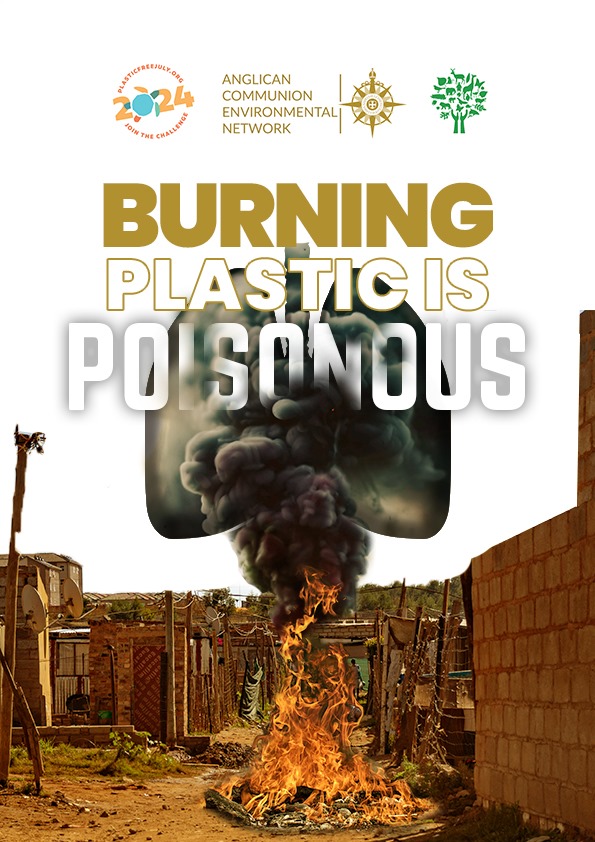
BURNING PLASTIC IS POISONOUS!

We continue our series of posts on the impact of plastic on the most vulnerable communities as part of the Plastic Free July campaign As much as one billion tonnes of waste could be burning in open fires   – almost half of the municipal solid waste generated on Earth is burned. The impact on human health in poorer communities is extreme. “Uncontrolled waste fires burn at much lower temperatures, which means combustion is incomplete. This releases substances from the waste and creates new ones as molecules are decomposed and reformed in the flames. Dioxins and related compounds are often formed when PVC is burned in open fires. At least 30 of these types of compound are considered harmful to human health. They can persist in the environment for years and in the human body for perhaps a decade or more. There is the danger that  they can damage the brain and disrupt hormones.”(Velis C, the Conversation) In wealthy countries waste may be burned in  Energy-from- waste plants (EFW), using expensive equipment . This is a very expensive process so is often exported to lower and middle income countries where it is burnt openly . Globally two billion people do not have their solid waste collected at all, which means they have no choice but to burn it or throw it in the river if there is one nearby. Another risk is that of electronic equipment, some informal recyclers burn away the PVC insulation to reach the copper and other metals  to be sold, releasing toxic fumes. The burning  of plastic waste is a massive environmental and health challenge .   It is also  an issue of injustice and environmental racism. #plasticfreejuly

BURNING PLASTIC IS POISONOUS! Read More »

Plastic waste leads to flooding

“Plastic free July”- during this month we will be focussing on the impacts of plastic waste on the most vulnerable communities. According to Tearfund almost a quarter of the world’s population (over 2 billion people) living in  low- or middle-income countries don’t have access to solid waste management. Globally, we throw away about 300 million tonnes of plastic waste every year. That’s enough to cover almost 50,000 football pitches every day! Half of all plastic is now designed to be used only once before being thrown away. In middle class suburbs, waste is picked up regularly but in informal settlements it piles up. The reasons for poor service delivery are many and multi- factored. Sometimes informal  communities are not given “wheelie bins’ by the city but only plastic bags. These then get torn open by dogs. If skips are provided they may be too far to walk to, or children cannot reach over the edge. There are also issues of safety for municipal vehicles going into certain areas. Due to the drop in value of plastic, less and less is being collected by wastepickers – virgin plastic in South Africa is now cheaper than recycled. A study at an Anglican Church revealed that a person would need to collect 300 bottles to earn the price of a loaf of bread. This means the harmful impacts of all this plastic pollution are becoming more widespread and severe. But what impact does all this rubbish have on informal settlements?. Plastic pollution can lead to  flooding disasters Plastic pollution blocks waterways and can  exacerbate flooding which can lead to huge disasters and loss of life. Many communities across the world experience regular, flash flooding on a devastating scale – even after just a small amount of rainfall – as the plastic dumped in rivers and drains means excess water has nowhere to go. These horrendous events cause loss of life, and sweep away homes and businesses, and it’s often low-income communities who have little option but to live on the riverbanks or in densely populated urban areas who suffer the most. It is  people in poverty who are most affected. Plastic rubbish lying in water is a also a breeding ground for mosquitoes, flies and vermin that can transmit diseases like malaria to people in the area. Research has shown that the incidence of diarrhoeal disease is twice as high for people living among mismanaged waste.

Plastic waste leads to flooding Read More »

Diocese of Johannesburg Servers Guild : Protect, Preserve and Improve.

As part of their service to the Lord the Diocesan Servers from Diocese ofJohannesburg met at St. James Anglican Church in Diepkloof Soweto for anenvironmental workshop.The day started off with Ms. Palesa Phayane ( Servers Environmental Affairs Coordinator) sharing the mission of having an environmentaldesk within the server’s guild. The dream is to not only grow trees or pray for theenvironment but to use this as on opportunity of restoring biodiversity while alsoputting up climate smart vegetable gardens at parishes. The produce could bedonate to local shelters, orphanage or used for parish soup kitchens. She also addedthat servers are known to be united, supportive and strong willed which is whystarting this initiative within the server’s guild gives a better chance of success. Theenvironmental initiative within the Diocesan servers guild has got both short term andlong term activities which have been outlined.Mr Bino Makhalanyane shared a presentation on the impacts and effects of climatechange under the theme of “The Earth is the Sanctuary of God”. He called onmembers of the servers’ guild , who are called to serve God within His Sanctuary tonot only limit themselves within church walls but to know and understand that thewhole earth is full of His Glory (Isaiah 6:3). Therefore we also have the responsibilityof taking care of our common home which is the earth .Attendees were then divided into six groups where each group had to design what apossible logo for the environmental desk within the diocesan Servers Guild wouldlook like.The day ended with a short wellness meditation.The motto for the Diocesan Servers Guild environmental initiative will be :PROTECT the environment so that we have a healthy place to live,PRESERVE so that future generations get to experience what we did,IMPROVE in order to enhance our lives and that of the other life forms around us Photo Credit : Ofentse Mogotsi

Diocese of Johannesburg Servers Guild : Protect, Preserve and Improve. Read More »

Climate YES : SEE , JUDGE, ACT

On Monday 17 June 2024 , 43 young people from the ecumenical joined the Climate YES one day workshop on Generational Restoration under climate justice. Eco-champ Morena Pule ( attendee of CY 2023 Bootcamp) began the day with a brief bible study on See, Judge and Act using Deuteronomy 6 as the base of bible study, the aim here was to make attendees aware that we cannot do anything if we do not open our eyes and minds to see, then judge for us to reach the goal of eco-restoration as a generation. The day progressed with a hands-on activity where attendees had to think about the different communities in which they come from and identify areas which need to be converted into better habitats for all creation. Attendees also took time to look at the root causes and came up possible solutions. Some of the key solutions was the call to mobilize faith leaders and groom them into eco-champs as they have a seat in strategic government and private sector networks, the need for Climate Change issue to be an inter-generational thing and not just focus on young people as our context still listens more to elders than they would to young people. The day ended off with a message from the Free State Diocesan Mothers Union President who committed and pledge her support in mobilizing mothers to support and listen to young people when it came to issues of eco-restoration. Photo credit: Morena Pule  

Climate YES : SEE , JUDGE, ACT Read More »

Never Stop Dreaming: #Generational Restoration

On Saturday 15 June 2024 over 80 young people from across the Diocese of Matlosane gathered together at the Diocesan Centre to celebrate nation youth day under the theme of Care for Creation . The day started of with an outside eucharist service lead by the Diocesan Bishop , where he encouraged the youth to new stop dream and chasing their dreams to become reality, but equally so they should learn to let go of things that keep hold one back from achieving the ultimate goal. He also encouraged the youth to take care of the environment by getting involved and embracing the Green Anglicans movement, as we only have one common home with all creation and need to therefore, they is a need to live in harmony with all creation. After the service the young people went into different groups for a bible study under the theme of :Generational Restoration , where they had to observe they’re surroundings and notice what has been broken, develop a plan and list action points. Part of the bible group discussions was for each group to look at how best young people can Recycle, Reuse and Reduce Plastic, Tins and Bottles. The day ended with the #Serethe challenges where the Bishop Diseko, Diocesan Servers Chaplain Revd Setlhafuno ,Diocesan Youth Coordinator Kgowe Moleme, Diocesan Green Anglicans Coordinator Ven. Peme and all young people took part as part of the provincial challenge .  Photo credit : Kgowe Moleme

Never Stop Dreaming: #Generational Restoration Read More »