
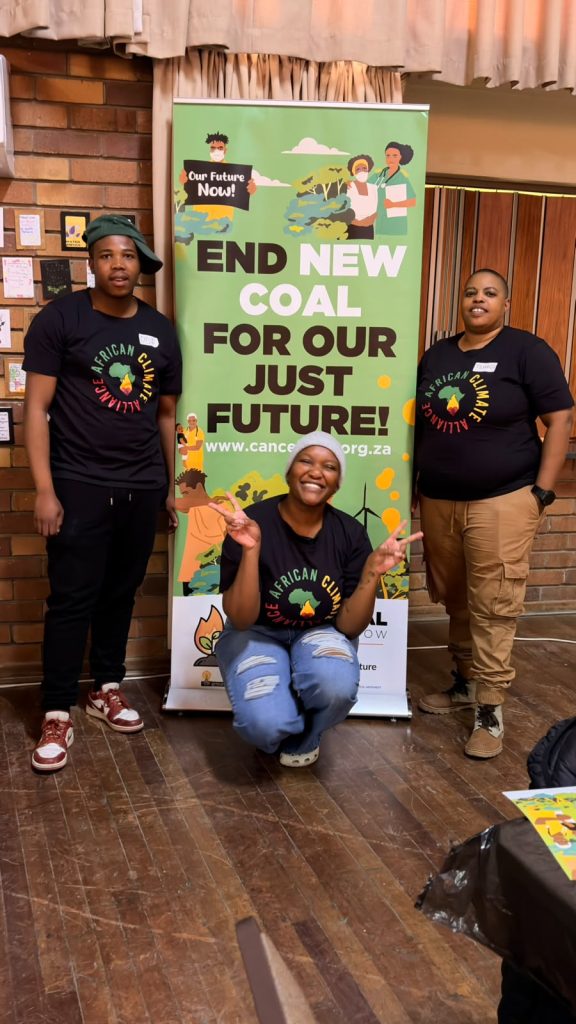
On 18 August 2026, we gathered in Bloemfontein, Free State, in solidarity with the Africa Climate Alliance (ACA) at a particularly significant moment for South Africa’s climate justice movement.
The gathering came as the government pursued its appeal against the landmark #CancelCoal judgment, which challenged plans for additional coal-fired electricity generation. For us, the timing of the solidarity event was a reminder that climate change is not simply an environmental issue. It is a question of justice, human dignity, health and the future we leave for generations to come.
Why Does This Matter to Young People?
For young people, the climate crisis is not a distant possibility. We are already living with its consequences, and we will carry them for the longest. Decisions made today about energy, development and the environment will shape the South Africa we inherit tomorrow. The #CancelCoal case has therefore become more than a legal battle over electricity generation. It represents a wider question: Do young people have a meaningful voice in decisions that determine the future we will live in?
Our presence at the solidarity event reflected our refusal to remain passive. We believe young people must be part of conversations about climate policy, energy, development and environmental justice. We are not simply “leaders of tomorrow”. We are citizens of today, and our voices deserve to be heard today.
What Does It Mean for a Church Environmental Network?
For Green Anglican, the environmental network of the Anglican Church of Southern Africa, being present at a climate justice gathering is an important expression of our ministry. Our faith teaches us that creation is not merely a resource for human consumption. It is something entrusted to us. Therefore, caring for creation must extend beyond what happens within our church buildings.
Green Anglican’s presence represents a Church willing to engage with the realities facing communities beyond the sanctuary. It reminds us that environmental ministry includes advocacy, education, action and solidarity, alongside practical initiatives such as reducing waste, planting trees and encouraging sustainable living.
Being present alongside the Africa Climate Alliance also creates an opportunity for the Church to listen and learn from movements that are already doing important work in the climate justice space. For us, this is what Green Anglican should represent: a faith community that does not only pray for creation, but actively works to protect it.
Faith Must Become Action
There is something powerful about a church environmental network standing alongside young climate activists. It demonstrates that faith and environmental justice are not competing ideas. Caring for creation is an expression of caring for people. The communities most vulnerable to environmental degradation are often those with the fewest resources to protect themselves from its consequences. Climate justice therefore requires us to ask not only what is happening to the environment? but also who is affected, who benefits and who carries the cost?
This is where the Church has an important role to play. Our theology calls us towards stewardship, but stewardship must be accompanied by responsibility. We cannot speak about loving our neighbours while ignoring the environmental conditions that affect their health, livelihoods and futures.
What Does This Reflect About Us?
Our presence in Bloemfontein reflected a generation that is becoming increasingly conscious of its responsibility. It reflected our willingness to listen, to learn and to stand with others whose struggles are connected to our own. It also reflected a Church that recognises that faith must be lived beyond the walls of the sanctuary. Climate justice asks us to move from prayer to action, from awareness to advocacy and from concern to solidarity. We may not have the power to make every decision, but we have the power to ask questions, to organise, to educate, to participate and to demand accountability.
The solidarity event reminded us that the climate movement is ultimately about people and the kind of future we are willing to build. For Green Anglicans, this is a call to continue strengthening the relationship between faith, young people and environmental justice.
We have been entrusted with creation, but we have also been entrusted with one another.
To care for one without caring for the other is to misunderstand both our faith and our responsibility. As young people, as people of faith and as members of Green Anglican, we therefore choose solidarity.
We choose to speak.
We choose to participate.
We choose to care.
And we choose to believe that a just, sustainable and God-honouring future is still worth fighting for.
By I. Madikgetla, T. Lekgetho and O. Sepato ( Green Anglicans eco-champs)
 |
 |