
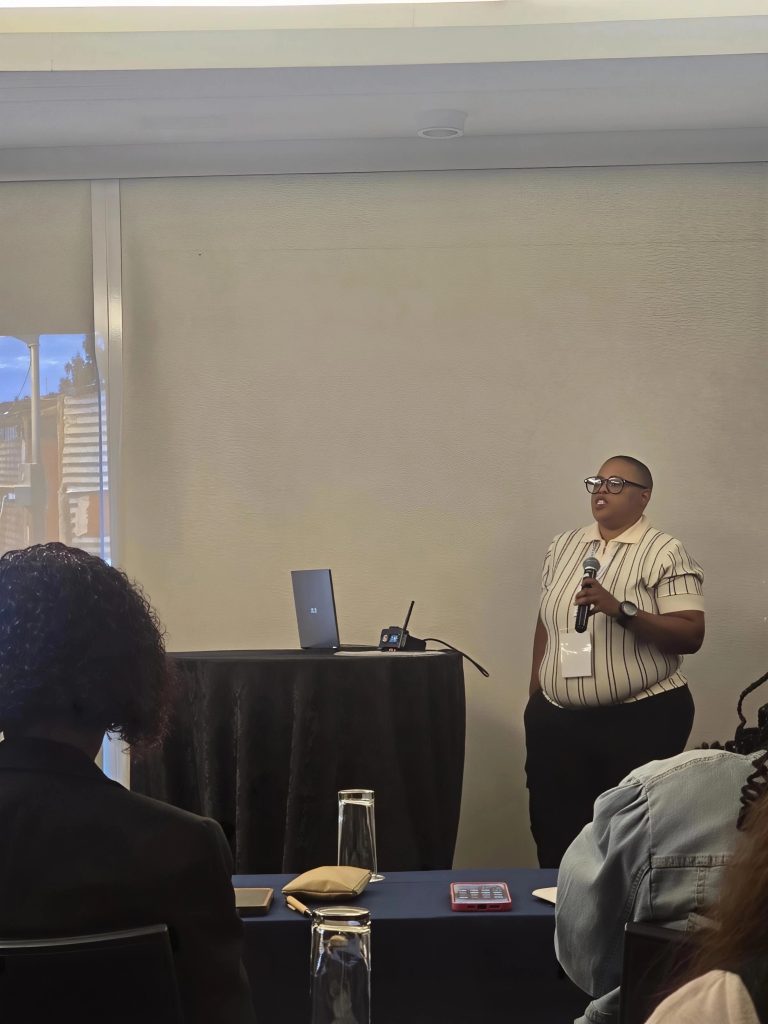
Tshegofatso Lekgetho, a Green Anglican and postgraduate researcher at the University of South Africa (UNISA), participated in the COMMRE 2026 Conference, held at the Durban International Convention Centre (ICC) from 27 to 30 October 2026.
The conference brought together researchers and professionals to share knowledge and explore solutions to environmental, climate and sustainability challenges.
Lekgetho delivered a lightning talk titled “Energy Poverty and Adaptive Capacity in South African Informal Settlements: A Conceptual Framework for Decentralized Renewable Energy as a Climate Adaptation Strategy.”
Her presentation explored the relationship between energy poverty and climate change, particularly how limited access to safe, affordable and reliable energy affects the ability of vulnerable communities to prepare for, respond to and recover from climate-related disasters.
Energy Access Is a Matter of Climate Justice
For many households living in informal settlements, access to electricity remains a daily challenge. Families often depend on unsafe or unreliable energy sources for cooking, lighting, heating and other essential needs.
These challenges become even more serious during extreme weather events, when access to energy can influence household safety, communication and emergency preparedness.
Through her research, Lekgetho highlighted the potential of decentralized renewable energy solutions, including solar technologies, to strengthen community resilience and support climate adaptation.
Her work emphasises that renewable energy should not only be viewed as a means of reducing carbon emissions but also as a practical tool for addressing inequality and improving the lives of vulnerable communities.
Connecting Research, Faith and Environmental Justice
As an active member of the Green Anglicans movement within the Anglican Church, Lekgetho’s participation reflects the important connection between faith, environmental stewardship and social justice.
The Green Anglicans movement encourages Christians to care for God’s creation while responding to the environmental challenges affecting communities, particularly those who are most vulnerable.
Her research contributes to this mission by drawing attention to energy poverty as an issue of human dignity, environmental justice and climate resilience.
The presentation also demonstrated the importance of bringing community-centred perspectives into academic and policy discussions about climate change.
Taking Climate Justice Beyond the Conference
Lekgetho’s participation at COMMRE 2026 represents another step in her academic journey and her commitment to advancing practical solutions for vulnerable communities.
Her ongoing postgraduate research focuses on investigating and modelling the feasibility of renewable energy solutions in informal settlements, using Turflaagte in Bloemfontein as a case study.
Through this work, she hopes to contribute evidence that can inform more inclusive energy planning and strengthen the resilience of energy-poor communities.
Her participation serves as a reminder that caring for creation also means caring for the people who depend on it.
Climate justice must go beyond protecting the planet. It must also ensure that no community is left behind in the transition towards a sustainable and climate-resilient future.
By : Tshegofatso Lekgetho