
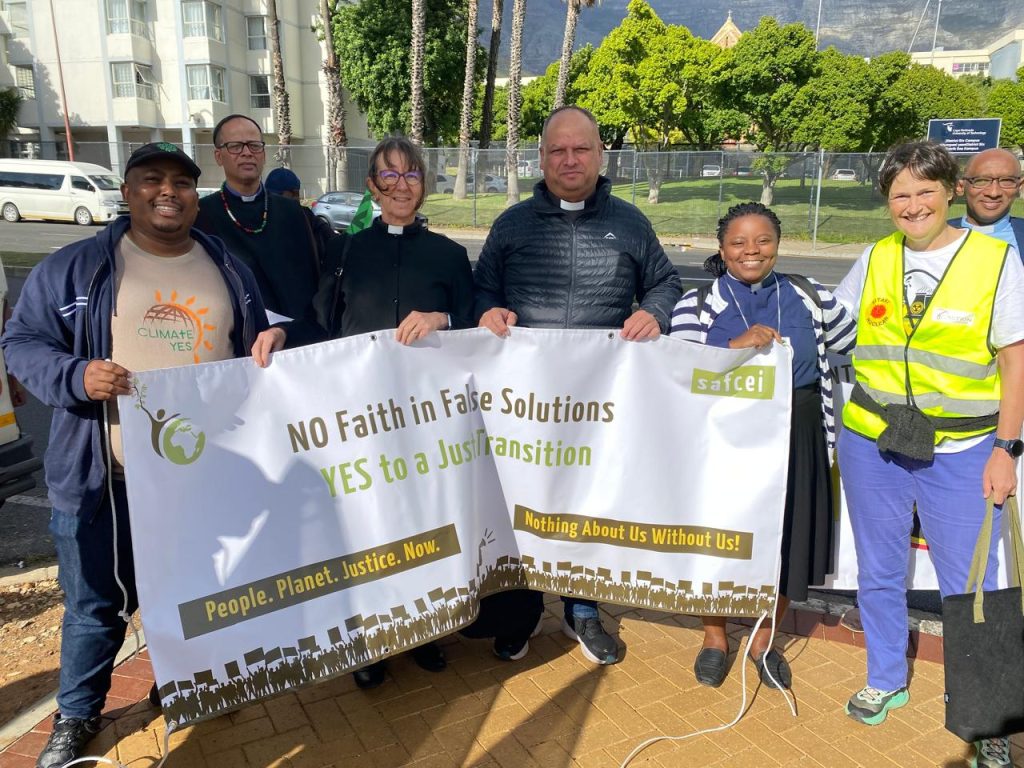
On Earth Day 2026, the theme “Our Power, Our Planet” came alive not just in words, but in movement. In Cape Town, over 500 people took to the streets, marching to Parliament under a shared banner: #NoFaithInFalseSolutions. What unfolded was more than a protest—it was a visible, collective call for a different future.
Civil society came together in remarkable unity. Faith-based organisations stood alongside environmental justice movements, community groups, and youth activists. Their message was clear: the time for half-measures and harmful detours is over. South Africa needs urgent, people-centred climate action and a truly just transition—one that protects both people and the planet.
At the heart of the march was a rejection of what activists describe as “false solutions.” These include new oil and gas developments, so-called “clean coal,” and carbon capture schemes. While often presented as pathways forward, these approaches risk deepening inequality, entrenching environmental harm, and delaying the rapid transition that the climate crisis demands.
The urgency of the crisis is not abstract. It is lived daily. As Lisa Makuala of The Green Connection reminded the crowd, “37% of South Africans live below the poverty line. It remains unfair for vulnerable communities to have to choose between buying bread and affording electricity.” Climate justice, therefore, cannot be separated from economic justice. The call is for a Just Transition—one that prioritises affordable, decentralised renewable energy and safeguards the dignity and rights of those most affected by rising costs and deepening food insecurity.
The march was convened by a broad coalition, including SAFCEI, Fossil Free South Africa, Africa Climate Alliance, The Green Connection, Natural Justice, the South Durban Community Environmental Alliance, Project 90 by 2030, and Extinction Rebellion Cape Town. They were joined by partners such as Green Anglicans, Greenpeace Africa, Beauty Without Cruelty, and many others. Together, they embodied a growing national movement—diverse, determined, and rooted in both justice and hope.
At Parliament, organisers handed over a joint memorandum to a Member of Parliament, calling for accountable leadership, inclusive climate policies, and real solutions. The memorandum emphasised that many of the so-called solutions currently being advanced by government and industry fail to consider their true social and economic impacts—and may not even meaningfully reduce emissions.
Among the voices raised was Rev Rachel Mash of Green Anglicans, who grounded the climate crisis in everyday realities:
“Paraffin prices have risen and many families battle to cook hot food in this cold weather. Taxi fares have gone up—and many are struggling to make ends meet at the end of the month. All because of a war in the Middle East. If your fuel comes on a ship, then you are not a sovereign nation. God has given us sun and wind—let us use them and speed up the transition away from fossil fuels so that we can fight energy poverty in our communities. Let us roll out training in renewables in every TVET college across the country.”
Her words point to a deeper truth: energy is not only an environmental issue, but a matter of justice, sovereignty, and human dignity. Renewable energy offers not just a cleaner future, but a fairer one—if implemented with intention and inclusion.
This Earth Day, the streets of Cape Town told a story of courage and conviction. A story of people refusing to accept false promises, and instead demanding real, transformative change. The message echoed beyond the march itself:
Our power. Our planet. No more false solutions.
For more on the memorandum handed to Parliament, see: https://tinyurl.com/3weeh6m9
