
“At least there is hope for a tree:
if it is cut down, it will sprout again,
and its new shoots will not fail.
Its roots may grow old in the ground
and its stump die in the soil,
yet at the scent of water it will bud
and put forth shoots like a plant.”
— Job 14:7–9
The Green Anglicans movement is embracing Farmer Managed Natural Regeneration (FMNR), a simple yet transformative approach to ecological restoration.
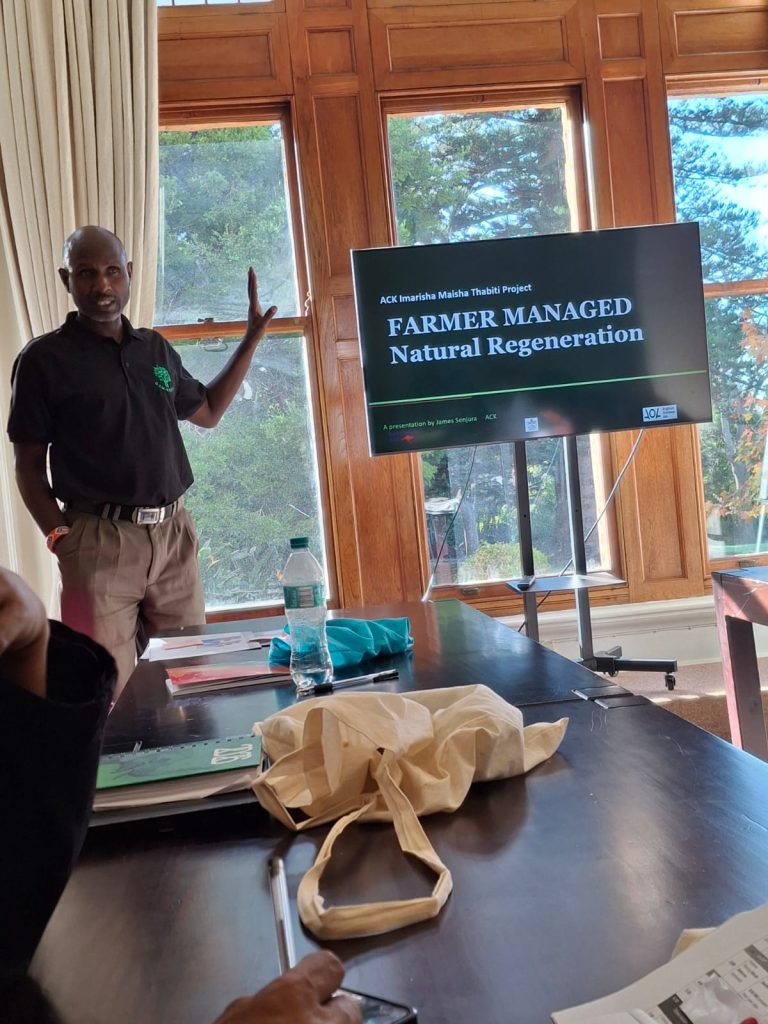
At a recent gathering of Anglican partners hosted by Anglican Overseas Aid, James Senjura from the Anglican Church of Kenya introduced partners to this life-giving technique. The partners came from South Sudan, South Africa, Kenya, Uganda, Mozambique and Ethiopia.
Instead of planting new trees, FMNR encourages farmers to protect and manage the natural regrowth of trees and shrubs from existing root systems, seeds, and living stumps already present in the soil. This simple but powerful method has restored millions of hectares of degraded land, especially across Africa.
FMNR works by selecting healthy shoots that emerge naturally from old stumps or roots and carefully pruning them to encourage strong growth. Farmers then protect these trees from fire, overgrazing, and unnecessary cutting. As the trees mature, they improve soil fertility, reduce erosion, increase water retention, and provide shade for crops and livestock. Trees also provide fuelwood, fodder, fruits, and building materials, creating additional sources of income for families.
One of the greatest strengths of FMNR is that it empowers local communities. Farmers use their own knowledge and resources, making the approach affordable, sustainable, and deeply rooted in local practice. In regions affected by drought and climate change, FMNR has strengthened food security and resilience by restoring ecosystems and improving agricultural productivity.
FMNR also contributes to addressing the global climate crisis. Restored trees capture carbon dioxide, support biodiversity, and revive damaged landscapes. By working with nature rather than against it, FMNR demonstrates how simple environmental practices can bring social, economic, and ecological healing.
Churches across northern Kenya and Zambia are already using the technique and seeing harvests increase. The Anglican Church of Zimbabwe is going to be working with Foundations for Farming to promote the technique
In Southern Africa, the Green Anglicans will partner with World Vision Southern Africa to roll out training in this simple but significant practice. The idea was initially brought to World Vision by Tony Rinauldo, who saw it successfully used in extremely dry regions of West Africa where tree growing once seemed impossible.
He later shared this story in his book The Forest Underground, a message of hope for a planet in crisis.
Across Africa, lands have been denuded and forests cut down, yet the forest still lives underground. May the stumps live again for the healing of the nations.


